Fixed-Support Barycenter by Benamou et al. (2015)
fbary15B.RdGiven \(K\) empirical measures \(\mu_1, \mu_2, \ldots, \mu_K\) of possibly different cardinalities, wasserstein barycenter \(\mu^*\) is the solution to the following problem $$\sum_{k=1}^K \pi_k \mathcal{W}_p^p (\mu, \mu_k)$$ where \(\pi_k\)'s are relative weights of empirical measures. Here we assume either (1) support atoms in Euclidean space are given, or (2) all pairwise distances between atoms of the fixed support and empirical measures are given. The historical method used iterative Bregman projections. The current compatibility implementation is described in Details.
Usage
fbary15B(
  support,
  atoms,
  marginals = NULL,
  weights = NULL,
  lambda = 0.1,
  p = 2,
  ...
)

fbary15Bdist(
  distances,
  marginals = NULL,
  weights = NULL,
  lambda = 0.1,
  p = 2,
  ...
)
Arguments
- support
an \((N\times P)\) matrix of rows being atoms for the fixed support.
- atoms
a length-\(K\) list where each element is an \((N_k \times P)\) matrix of atoms.
- marginals
marginal distribution for empirical measures; if
NULL(default), uniform weights are set for all measures. Otherwise, it should be a length-\(K\) list where each element is a length-\(N_i\) vector of nonnegative weights that sum to 1.- weights
weights for each individual measure; if
NULL(default), each measure is considered equally. Otherwise, it should be a length-\(K\) vector.- lambda
regularization parameter (default: 0.1).
- p
an exponent for the order of the distance (default: 2).
- ...
extra parameters including
- abstol
stopping criterion for iterations (default: 1e-10).
- init.vec
an initial vector (default: uniform weight).
- maxiter
maximum number of iterations (default: 496).
- print.progress
a logical to show current iteration (default: FALSE).
- distances
a length-\(K\) list where each element is an \((N\times N_k)\) pairwise distance between atoms of the fixed support and given measures.
Value
A numeric t4transport_mass vector with a diagnostics
attribute and a compatible barplot method.
Use return_result = TRUE to return the full fit instead.
Details
Since version 0.2.0, the historical entry points use the shared
objective-checked mirror-descent solver with log-domain Sinkhorn inner
solves. Their names are retained for compatibility, not as a claim that
the original accelerated or Bregman-projection iteration is still used.
The optimized cost is distance raised to p, plus
lambda * sum(plan * (log(plan) - 1)). Locations are fixed and
candidate probability masses vary. Inspect status and the reported convex
objective bound; exhausting the iteration budget is not success.
Additional controls are rtol, step0, max_backtrack,
inner_maxiter, inner_tol, and return_result.
Initial masses must be strictly positive.
References
Benamou J, Carlier G, Cuturi M, Nenna L, Peyré G (2015). “Iterative Bregman Projections for Regularized Transportation Problems.” SIAM Journal on Scientific Computing, 37(2), A1111-A1138. ISSN 1064-8275, 1095-7197, doi:10.1137/141000439 .
Examples
# \donttest{
#-------------------------------------------------------------------
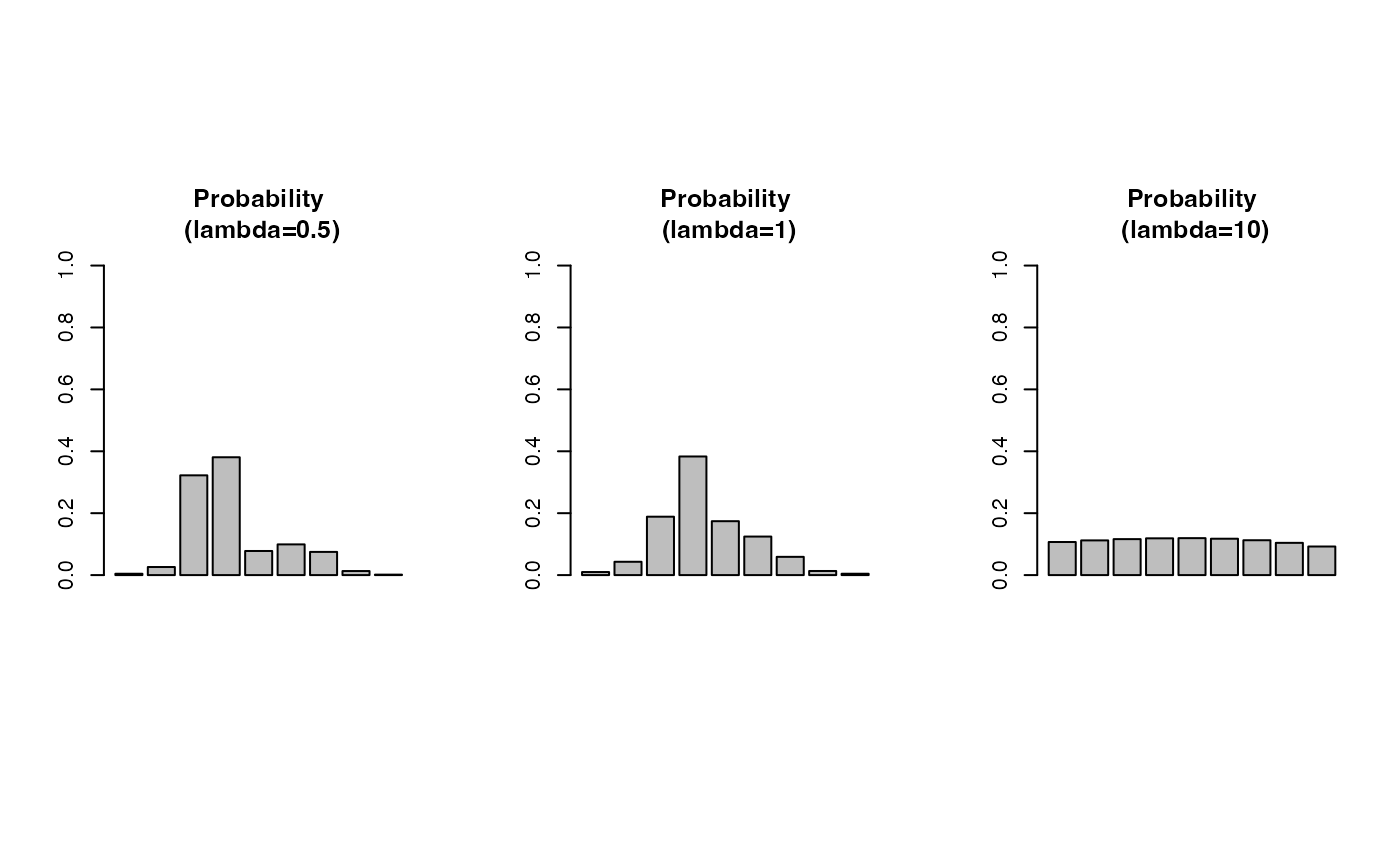
# Wasserstein Barycenter for Fixed Atoms with Two Gaussians
#
# * class 1 : samples from Gaussian with mean=(-4, -4)
# * class 2 : samples from Gaussian with mean=(+4, +4)
# * target support consists of 7 integer points from -6 to 6,
# where ideally, weight is concentrated near 0 since it's average!
#-------------------------------------------------------------------
## GENERATE DATA
# Empirical Measures
set.seed(100)
ndat = 20
dat1 = matrix(rnorm(ndat*2, mean=-4, sd=0.5),ncol=2)
dat2 = matrix(rnorm(ndat*2, mean=+4, sd=0.5),ncol=2)
myatoms = list()
myatoms[[1]] = dat1
myatoms[[2]] = dat2
mydata = rbind(dat1, dat2)
# Fixed Support
support = cbind(seq(from=-8,to=8,by=2),
seq(from=-8,to=8,by=2))
## COMPUTE
comp1 = fbary15B(support, myatoms, lambda=0.5, maxiter=10)
#> Warning: fbary15B finished with status 'iteration_limit': maximum_iterations. Inspect attr(result, 'diagnostics').
comp2 = fbary15B(support, myatoms, lambda=1, maxiter=10)
#> Warning: fbary15B finished with status 'iteration_limit': maximum_iterations. Inspect attr(result, 'diagnostics').
comp3 = fbary15B(support, myatoms, lambda=10, maxiter=10)
#> Warning: fbary15B finished with status 'iteration_limit': maximum_iterations. Inspect attr(result, 'diagnostics').
## VISUALIZE
opar <- par(no.readonly=TRUE)
par(mfrow=c(1,3), pty="s")
barplot(comp1, ylim=c(0,1), main="Probability\n (lambda=0.5)")
barplot(comp2, ylim=c(0,1), main="Probability\n (lambda=1)")
barplot(comp3, ylim=c(0,1), main="Probability\n (lambda=10)")
 par(opar)
# }