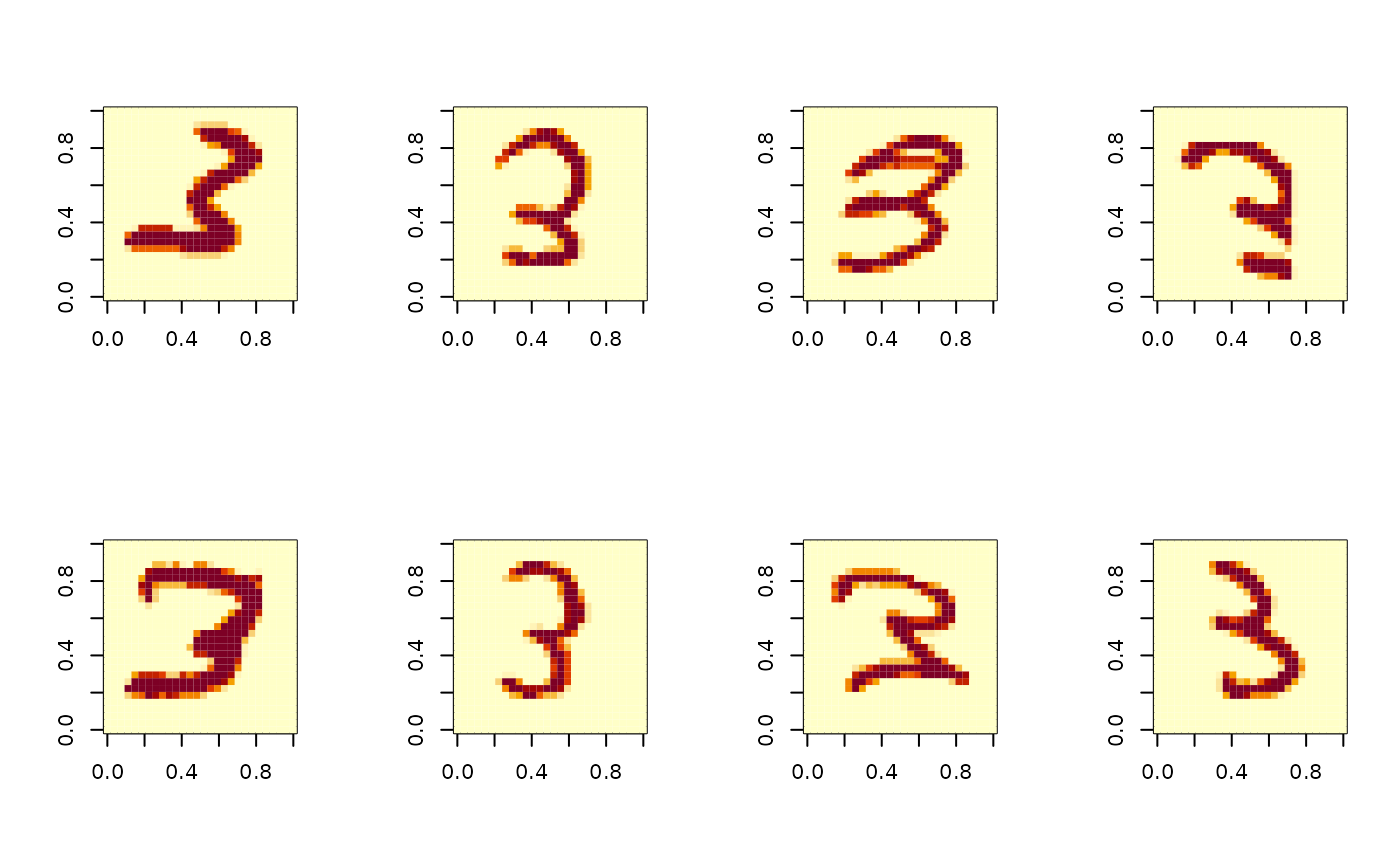
MNIST Images of Digit 3
digit3.Rddigit3 contains 2000 images from the MNIST dataset of digit 3.
Each element of the list is an image represented as an \((28\times 28)\)
matrix that sums to 1. Normalization makes intensities into probability
masses and discards the original total intensity of each image.
Usage
data(digit3)Source
MNIST Database of Handwritten Digits, by Yann LeCun, Corinna
Cortes, and Christopher J.C. Burges, http://yann.lecun.com/exdb/mnist/.
The original package source does not preserve this subset's MNIST row
indices, train/test designation, random seed, or exact preparation code.
See the installed DATA_PROVENANCE for source-artifact checksums and
the limits of the provenance and dataset-specific licensing evidence.
References
LeCun, Y., Bottou, L., Bengio, Y., and Haffner, P. (1998). Gradient-based learning applied to document recognition. Proceedings of the IEEE, 86(11), 2278–2324. doi:10.1109/5.726791 .