Given \(N\) observations \(X_1, X_2, \ldots, X_N\) in SPD manifold, compute pairwise distances among observations. Stein distances use a scaled relative spectrum, and Wasserstein distances use an aligned Cholesky-factor residual, avoiding determinant overflow and cancellation of nearly equal traces. Numerically singular inputs can still prevent these factorizations and are reported as errors.
Arguments
- spdobj
a S3
"riemdata"class of SPD-valued data.- geometry
name of the geometry to be used. See
spd.geometryfor supported geometries.- as.dist
logical; if
TRUE, it returns adistobject. Else, it returns a symmetric matrix.
Value
a S3 dist object or \((N\times N)\) symmetric matrix of pairwise distances according to as.dist parameter.
Validation status
This retained legacy interface is experimental. Its full numerical and
statistical contract has not been independently verified across supported
inputs. See riem-method-contracts and the installed contract
table for method-specific assumptions, restrictions, and evidence scope.
Examples
# \donttest{
#-------------------------------------------------------------------
# Two Types of Covariances
#
# group1 : perturbed from data by N(0,1) in R^3
# group2 : perturbed from data by [sin(x); cos(x); sin(x)*cos(x)]
#-------------------------------------------------------------------
## GENERATE DATA
spd_mats = array(0,c(3,3,20))
for (i in 1:10){
spd_mats[,,i] = stats::cov(matrix(rnorm(50*3), ncol=3))
}
for (j in 11:20){
randvec = stats::rnorm(50, sd=3)
randmat = cbind(sin(randvec), cos(randvec), sin(randvec)*cos(randvec))
spd_mats[,,j] = stats::cov(randmat + matrix(rnorm(50*3, sd=0.1), ncol=3))
}
## WRAP IT AS SPD OBJECT
spd_obj = wrap.spd(spd_mats)
## COMPUTE PAIRWISE DISTANCES
# Geometries are case-insensitive.
pdA = spd.pdist(spd_obj, "airM")
pdL = spd.pdist(spd_obj, "lErm")
pdJ = spd.pdist(spd_obj, "Jeffrey")
pdS = spd.pdist(spd_obj, "stEin")
pdW = spd.pdist(spd_obj, "wasserstein")
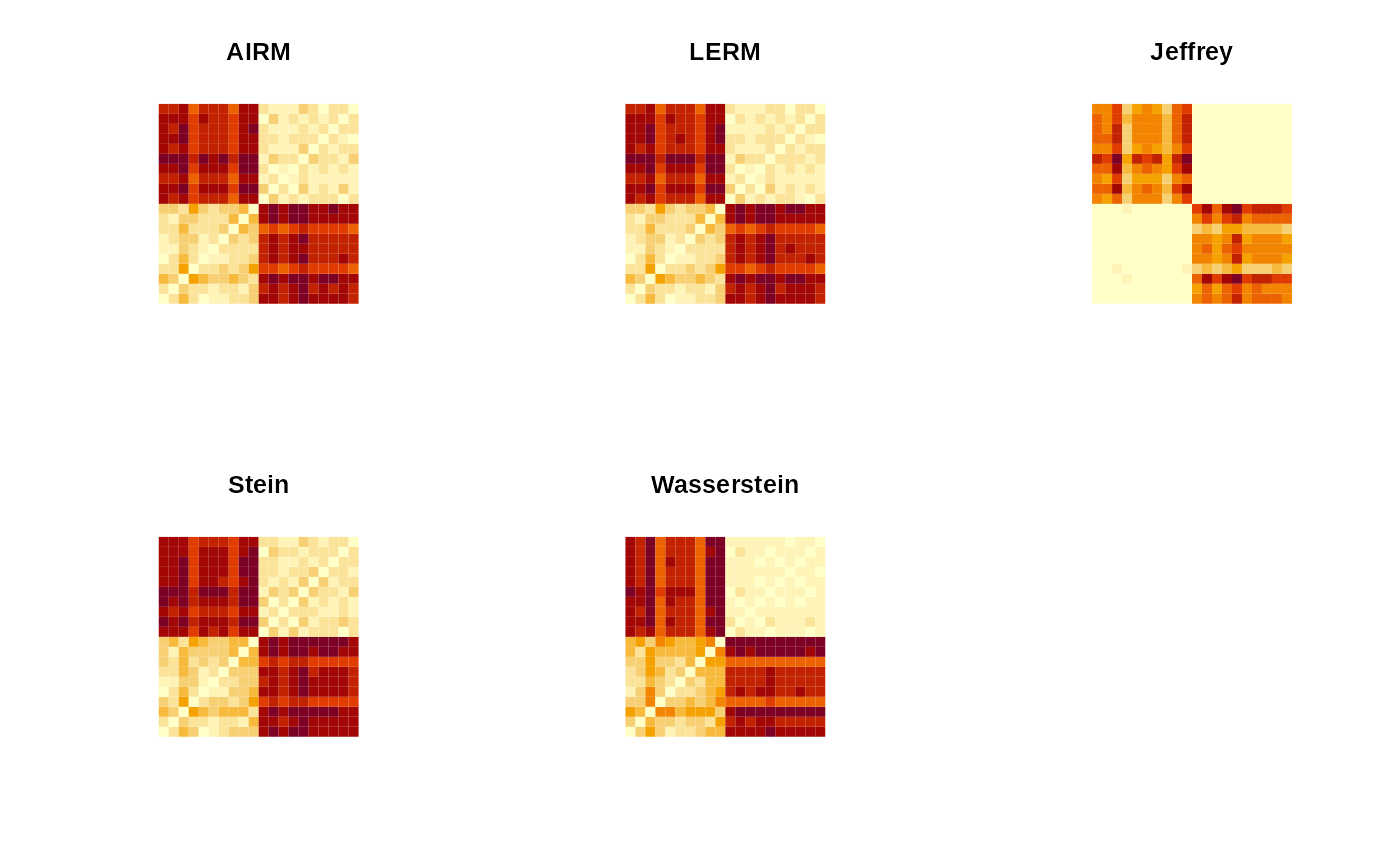
## VISUALIZE
opar <- par(no.readonly=TRUE)
par(mfrow=c(2,3), pty="s")
image(pdA, axes=FALSE, main="AIRM")
image(pdL, axes=FALSE, main="LERM")
image(pdJ, axes=FALSE, main="Jeffrey")
image(pdS, axes=FALSE, main="Stein")
image(pdW, axes=FALSE, main="Wasserstein")
par(opar)
 # }