
Given \(N\) observations \(X_1, X_2, \ldots, X_N \in \mathcal{M}\),
compute Fréchet mean and variation with respect to the geometry by minimizing
$$\textrm{min}_x \sum_{n=1}^N w_n \rho^2 (x, x_n),\quad x\in\mathcal{M}$$ where
\(\rho (x, y)\) is a distance for two points \(x,y\in\mathcal{M}\).
If non-uniform weights are given, normalized version of the mean is computed
and if weight=NULL, it automatically sets equal weights (\(w_i = 1/n\)) for all observations.
Arguments
- riemobj
a S3
"riemdata"class for \(N\) manifold-valued data.- weight
Finite nonnegative observation weights with positive sum. They are normalized internally.
NULLuses equal weights. Zero-weight observations are validated but do not enter the calculation.- geometry
Geometry name or specification.
NULLselects the default geometry. Legacy"intrinsic"and"extrinsic"aliases remain available for supported combinations. SPD names include"affine_invariant"and"log_euclidean".- ...
Named controls:
- maxiter
Positive maximum number of accepted iterations (default 50).
- eps
Positive absolute tolerance for the compatible gradient norm (default
1e-5).- max_backtrack
Positive maximum number of trial steps per iteration, at most 1024 (default 50).
- trace
Whether to retain the iteration history (default
FALSE).- init
Optional initial matrix with the observation dimensions. Closed-form calculations do not use an initializer.
Unknown controls are errors.
Value
A riem_summary object retaining mean and
variation, plus objective, resolved geometry, normalized
weights, converged, termination, iterations,
gradient_norm, step_norm, controls, and an optional trace.
variation equals the normalized weighted sum of squared distances
at the returned mean. An unsuccessful iteration warns and returns the last
accepted estimate. For a curved extrinsic embedding, diagnostics and trace
refer to the ambient calculation, as recorded in diagnostic_scope.
Details
Intrinsic iteration uses the average logarithm direction and an
Armijo backtracking rule for the stated squared-distance objective.
Euclidean and log-Euclidean SPD means use closed forms. On spaces with
nonconvex objectives, termination with "stationary" establishes
first-order stationarity to the requested tolerance only. A stationary
point may be a local minimum, a saddle, or a local maximum; the criterion
does not establish local minimality, uniqueness, or global optimality.
Examples
#-------------------------------------------------------------------
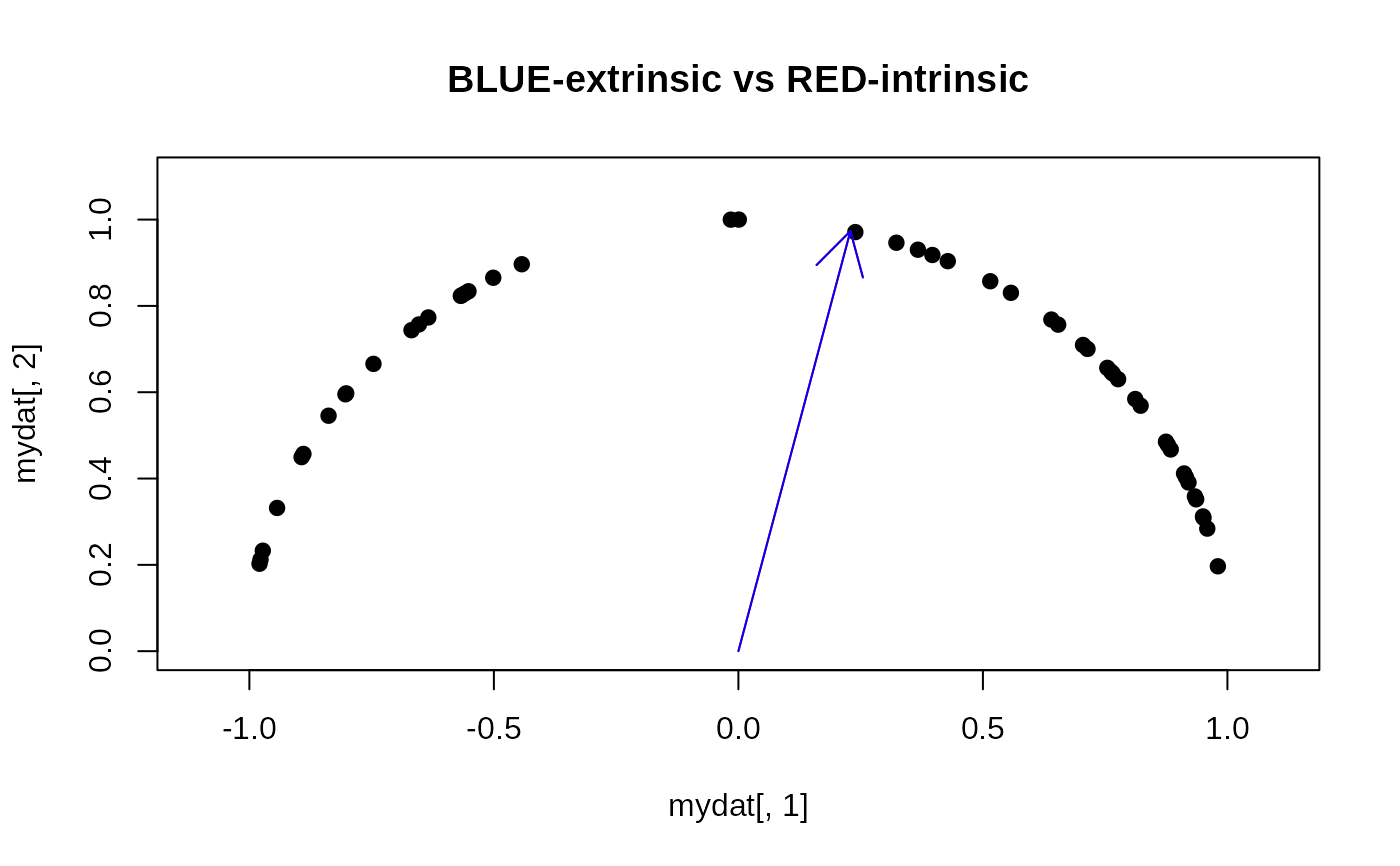
# Example on Sphere : points near (0,1) on S^1 in R^2
#-------------------------------------------------------------------
## GENERATE DATA
ndata = 50
mydat = array(0,c(ndata,2))
for (i in 1:ndata){
tgt = c(stats::rnorm(1, sd=2), 1)
mydat[i,] = tgt/sqrt(sum(tgt^2))
}
myriem = wrap.sphere(mydat)
## COMPUTE TWO MEANS
mean.int = as.vector(riem.mean(myriem, geometry="intrinsic")$mean)
mean.ext = as.vector(riem.mean(myriem, geometry="extrinsic")$mean)
## VISUALIZE
opar <- par(no.readonly=TRUE)
plot(mydat[,1], mydat[,2], pch=19, xlim=c(-1.1,1.1), ylim=c(0,1.1),
main="BLUE-extrinsic vs RED-intrinsic")
arrows(x0=0,y0=0,x1=mean.int[1],y1=mean.int[2],col="red")
arrows(x0=0,y0=0,x1=mean.ext[1],y1=mean.ext[2],col="blue")
 par(opar)