\(t\)-distributed Stochastic Neighbor Embedding (t-SNE) is a variant of Stochastic Neighbor Embedding (SNE) that mimicks patterns of probability distributinos over pairs of high-dimensional objects on low-dimesional target embedding space by minimizing Kullback-Leibler divergence. While conventional SNE uses gaussian distributions to measure similarity, t-SNE, as its name suggests, exploits a heavy-tailed Student t-distribution.
do.tsne(
  X,
  ndim = 2,
  perplexity = 30,
  eta = 0.05,
  maxiter = 2000,
  jitter = 0.3,
  jitterdecay = 0.99,
  momentum = 0.5,
  pca = TRUE,
  pcascale = FALSE,
  symmetric = FALSE,
  BHuse = TRUE,
  BHtheta = 0.25
)
Arguments
- X
an \((n\times p)\) matrix or data frame whose rows are observations and columns represent independent variables.
- ndim
an integer-valued target dimension.
- perplexity
desired level of perplexity; ranging [5,50].
- eta
learning parameter.
- maxiter
maximum number of iterations.
- jitter
level of white noise added at the beginning.
- jitterdecay
decay parameter in (0,1). The closer to 0, the faster artificial noise decays.
- momentum
level of acceleration in learning.
- pca
whether to use PCA as preliminary step;
TRUEfor using it,FALSEotherwise.- pcascale
a logical;
FALSEfor using Covariance,TRUEfor using Correlation matrix. See alsodo.pcafor more details.- symmetric
a logical;
FALSEto solve it naively, andTRUEto adopt symmetrization scheme.- BHuse
a logical;
TRUEto use Barnes-Hut approximation. SeeRtsnefor more details.- BHtheta
speed-accuracy tradeoff. If set as 0.0, it reduces to exact t-SNE.
Value
a named Rdimtools S3 object containing
- Y
an \((n\times ndim)\) matrix whose rows are embedded observations.
- algorithm
name of the algorithm.
References
van der Maaten L, Hinton G (2008). “Visualizing Data Using T-SNE.” The Journal of Machine Learning Research, 9(2579-2605), 85.
See also
Examples
# \donttest{
## load iris data
data(iris)
set.seed(100)
subid = sample(1:150,50)
X = as.matrix(iris[subid,1:4])
lab = as.factor(iris[subid,5])
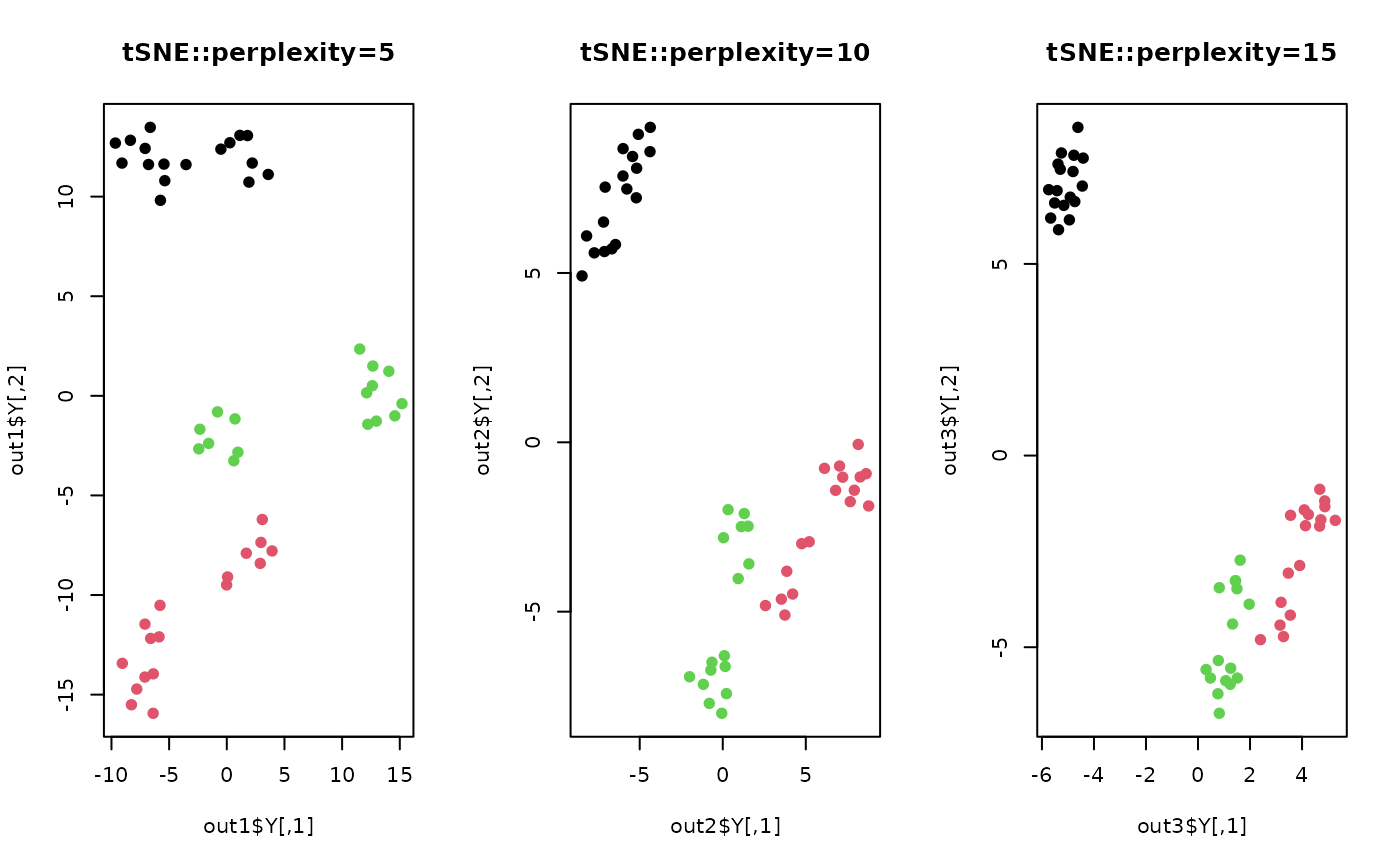
## compare different perplexity
out1 <- do.tsne(X, ndim=2, perplexity=5)
out2 <- do.tsne(X, ndim=2, perplexity=10)
out3 <- do.tsne(X, ndim=2, perplexity=15)
## Visualize three different projections
opar <- par(no.readonly=TRUE)
par(mfrow=c(1,3))
plot(out1$Y, pch=19, col=lab, main="tSNE::perplexity=5")
plot(out2$Y, pch=19, col=lab, main="tSNE::perplexity=10")
plot(out3$Y, pch=19, col=lab, main="tSNE::perplexity=15")
 par(opar)
# }
par(opar)
# }