Distance Measures between Samples through Empirical Cumulative Distribution Functions
Source:R/ecdfdistS.R
ecdfdistS.RdWe measure distance between two empirical cumulative distribution functions of the data.
Unlike ecdfdist, this function takes raw data samples as input, and
internally computes the empirical cumulative distribution functions (ECDF) for distance calculations.
ecdfdistS(
  veclist,
  method = c("KS", "Lp", "Wasserstein"),
  p = 1,
  as.dist = FALSE
)
Arguments
- veclist
a length \(N\) list of vectors.
- method
name of the distance/dissimilarity measure. Case insensitive (default:
ks).- p
exponent for
LporWassersteindistance (default:p=1).- as.dist
a logical;
TRUEto returndistobject,FALSEto return an \((N\times N)\) symmetric matrix of pairwise distances (default:FALSE).
Value
either dist object of an \((N\times N)\) symmetric matrix of pairwise distances by as.dist argument.
Examples
# \donttest{
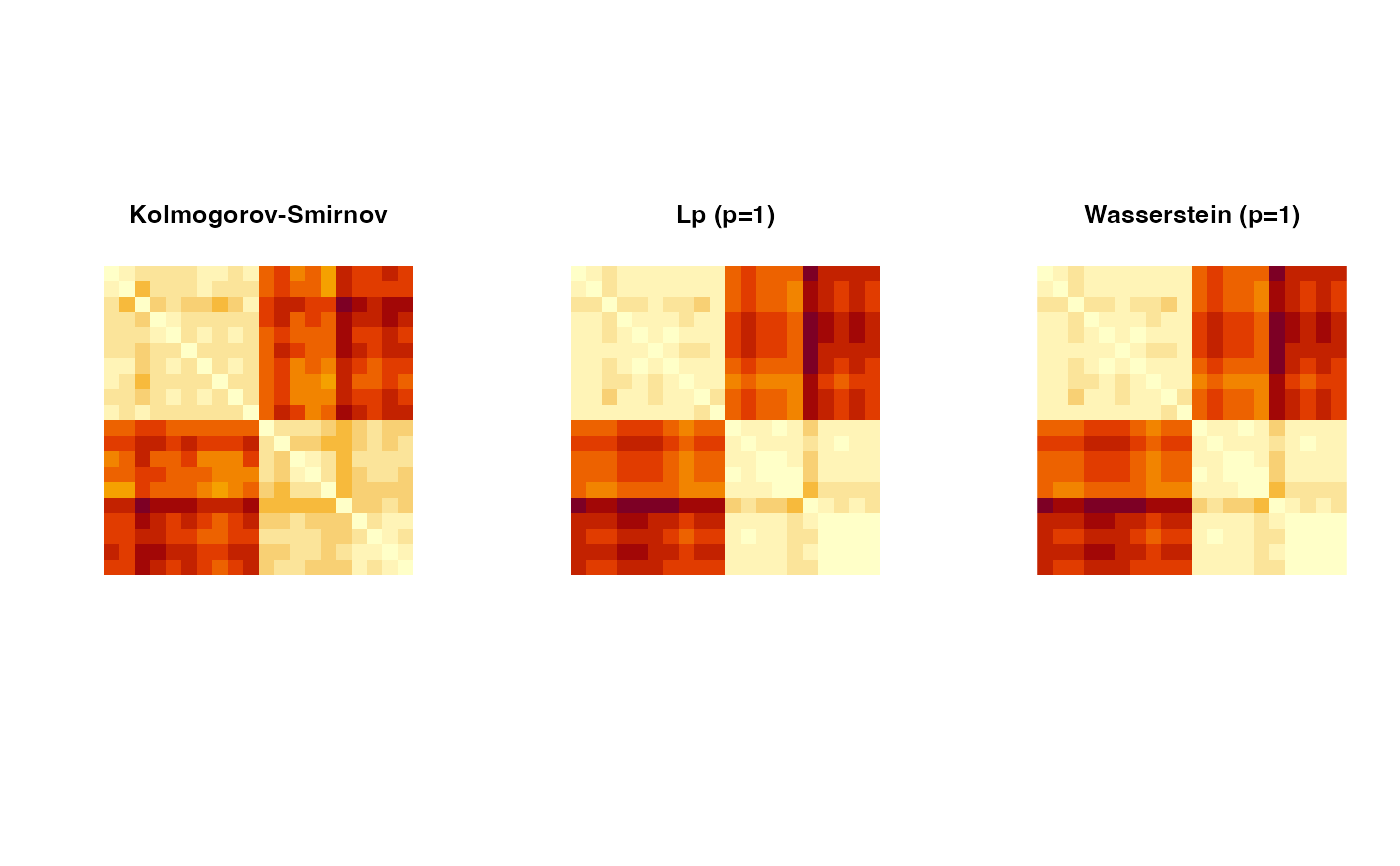
## toy example : 10 of random and uniform distributions
mylist = list()
for (i in 1:10){
mylist[[i]] = stats::rnorm(50, sd=2)
}
for (i in 11:20){
mylist[[i]] = stats::runif(50, min=-5)
}
## compute three distances
d_KS = ecdfdistS(mylist, method="KS")
d_LP = ecdfdistS(mylist, method="Lp")
d_OT = ecdfdistS(mylist, method="Wasserstein")
## visualize
opar = par(no.readonly=TRUE)
par(mfrow=c(1,3), pty="s")
image(d_KS[,nrow(d_KS):1], axes=FALSE, main="Kolmogorov-Smirnov")
image(d_LP[,nrow(d_LP):1], axes=FALSE, main="Lp (p=1)")
image(d_OT[,nrow(d_OT):1], axes=FALSE, main="Wasserstein (p=1)")
 par(opar)
# }
par(opar)
# }