Interpolation between Images
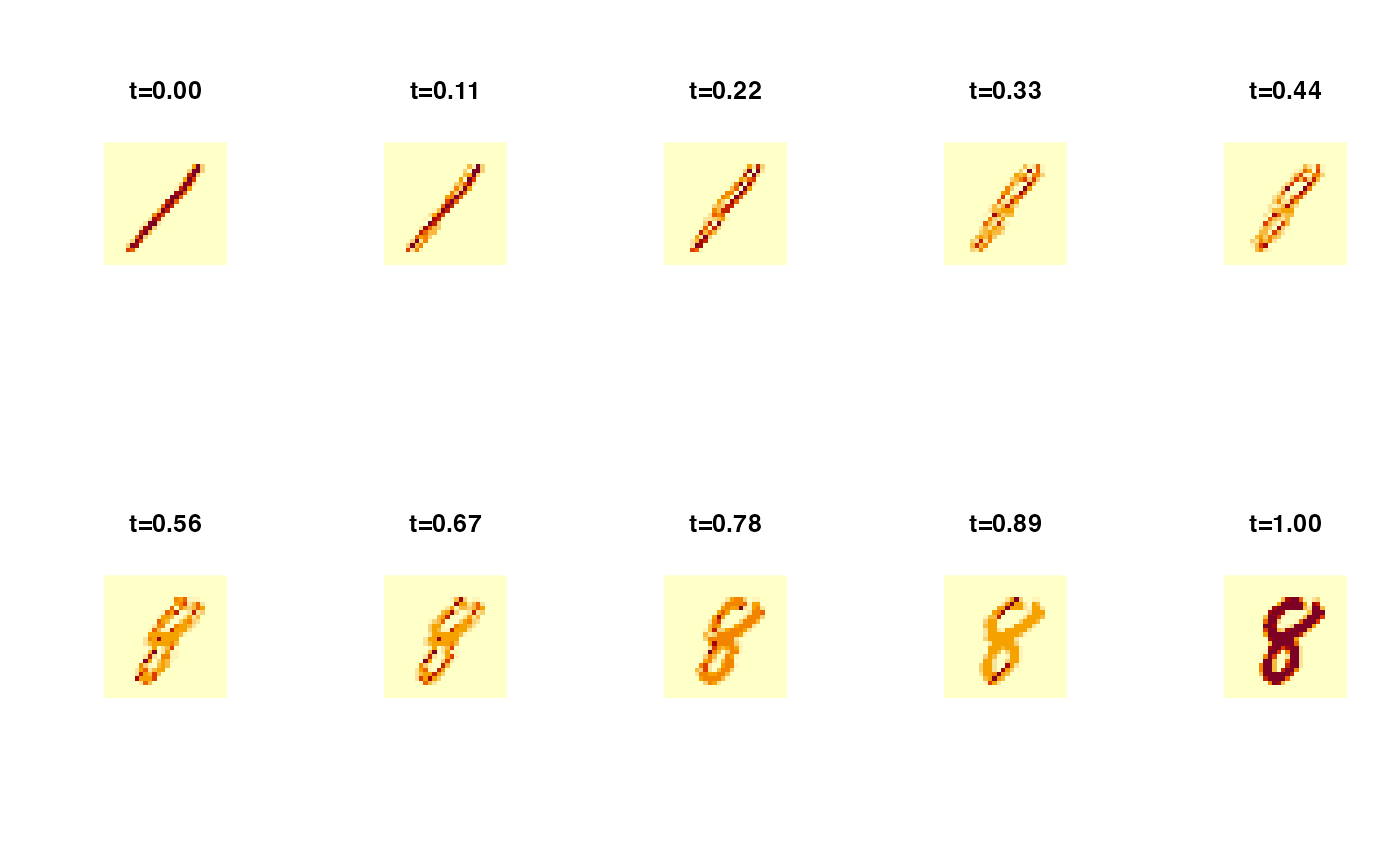
imageinterp.RdGiven two grayscale images represented as numeric matrices of identical size, compute interpolated images along a 2-Wasserstein geodesic connecting them, then projects it onto the original grid. The function interprets each image as a discrete probability distribution on a common \((m\times n)\) grid, computes an exact optimal transport plan, and constructs intermediate measures by pushing the plan through the linear interpolation map \(z=(1-t)x+t y\) (displacement interpolation / McCann's interpolation).
Arguments
- image1
a grayscale image matrix of size \((m\times n)\) with nonnegative entries.
- image2
another grayscale image matrix of size \((m\times n)\) with nonnegative entries.
- t
a scalar or numeric vector in \([0,1]\) specifying interpolation times.
t=0returnsimage1,t=1returnsimage2.- ...
extra parameters including
- eps
positivity floor applied after normalization (default:
0). A positive value changes the inputs; its mass perturbation is reported.- inner_maxiter
exact solver pivot budget (default: 100000000).
- project
only
nearestis supported.- abstol
tolerance used for internal mass checks (default:
1e-12).- print.progress
logical; if
TRUE, print basic diagnostics (default:FALSE).
Value
If length(t)==1, a single \((m\times n)\) matrix representing the interpolated image.
If length(t)>1, a length-length(t) list of \((m\times n)\) matrices.
Details
Because the interpolated support locations generally do not coincide with the original grid points, the resulting distribution is projected back onto the grid by depositing transported mass to the nearest grid location. The unprojected finite measure is retained in an attribute; the displayed matrix generally is not an exact Wasserstein geodesic.
Examples
# \donttest{
#----------------------------------------------------------------------
# Digit Interpolation between 1 and 8
#----------------------------------------------------------------------
# LOAD DATA
set.seed(11)
data(digits)
x1 <- digits$image[[sample(which(digits$label==1),1)]]
x2 <- digits$image[[sample(which(digits$label==8),1)]]
# COMPUTE
tvec <- seq(0, 1, length.out=10)
path <- imageinterp(x1, x2, t = tvec)
# VISUALIZE
opar <- par(no.readonly=TRUE)
par(mfrow=c(2,5), pty="s")
for (k in 1:10){
image(path[[k]], axes=FALSE, main=sprintf("t=%.2f", tvec[k]))
}
 par(opar)
# }
par(opar)
# }