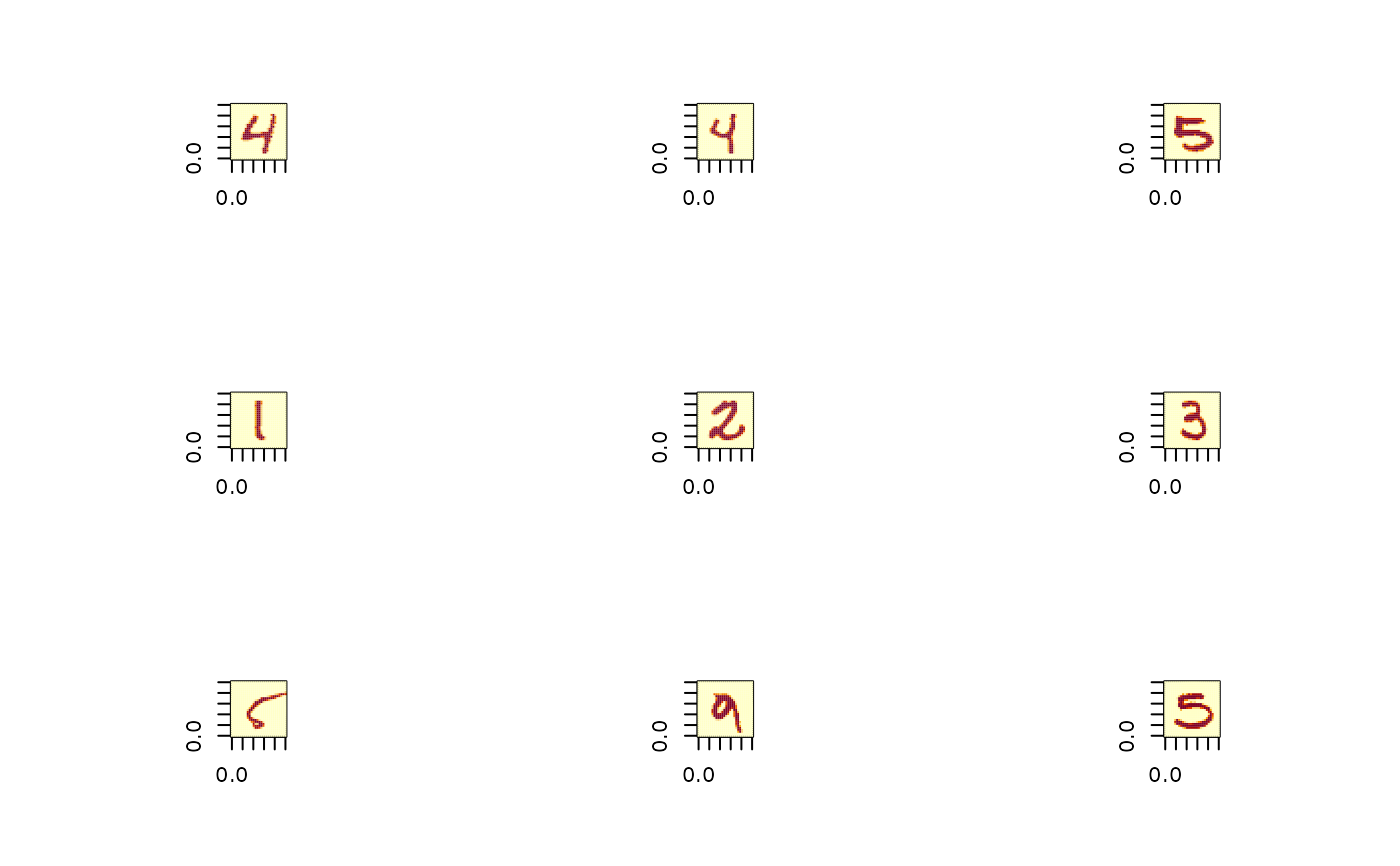
MNIST Images of All Digits
digits.Rddigits contains 5000 images from the MNIST dataset of all digits,
consisting of 500 images per digit class from 0 to 9.
Each digit image is represented as an \((28\times 28)\)
matrix that sums to 1. Normalization makes intensities into probability
masses and discards the original total intensity of each image.
Usage
data(digits)Format
a named list "digits" containing
- image
length-5000 list of \((28\times 28)\) image matrices.
- label
length-5000 vector of class labels from 0 to 9.
Source
MNIST Database of Handwritten Digits, by Yann LeCun, Corinna
Cortes, and Christopher J.C. Burges, http://yann.lecun.com/exdb/mnist/.
The retained preparation fragment uses dslabs::read_mnist(), samples
500 training images per class without replacement, reshapes each row with
matrix(pixel_vector, nrow = 28)[, 28:1], and normalizes total mass.
Its original random seed, selected MNIST row indices, and dslabs version
were not recorded. See the installed DATA_PROVENANCE for checksums,
transformations, and limits of the dataset-specific licensing evidence.
References
LeCun, Y., Bottou, L., Bengio, Y., and Haffner, P. (1998). Gradient-based learning applied to document recognition. Proceedings of the IEEE, 86(11), 2278–2324. doi:10.1109/5.726791 .