The version of Ng, Jordan, and Weiss first constructs the affinity matrix $$A_{ij} = \exp(-d(x_i, d_j)^2 / \sigma^2)$$ where \(\sigma\) is a common bandwidth parameter and performs k-means (or possibly, GMM) clustering on the row-space of eigenvectors for the symmetric graph laplacian matrix $$L=D^{-1/2}(D-A)D^{-1/2}$$.
scNJW(data, k = 2, sigma = 1, ...)Arguments
- data
an \((n\times p)\) matrix of row-stacked observations or S3
distobject of \(n\) observations.- k
the number of clusters (default: 2).
- sigma
bandwidth parameter (default: 1).
- ...
extra parameters including
- algclust
method to perform clustering on embedded data; either
"kmeans"(default) or"GMM".- maxiter
the maximum number of iterations (default: 10).
Value
a named list of S3 class T4cluster containing
- cluster
a length-\(n\) vector of class labels (from \(1:k\)).
- eigval
eigenvalues of the graph laplacian's spectral decomposition.
- embeds
an \((n\times k)\) low-dimensional embedding.
- algorithm
name of the algorithm.
References
Ng AY, Jordan MI, Weiss Y (2002). “On Spectral Clustering: Analysis and an Algorithm.” In Dietterich TG, Becker S, Ghahramani Z (eds.), Advances in Neural Information Processing Systems 14, 849–856. MIT Press.
Examples
# -------------------------------------------------------------
# clustering with 'iris' dataset
# -------------------------------------------------------------
## PREPARE
data(iris)
X = as.matrix(iris[,1:4])
lab = as.integer(as.factor(iris[,5]))
## EMBEDDING WITH PCA
X2d = Rdimtools::do.pca(X, ndim=2)$Y
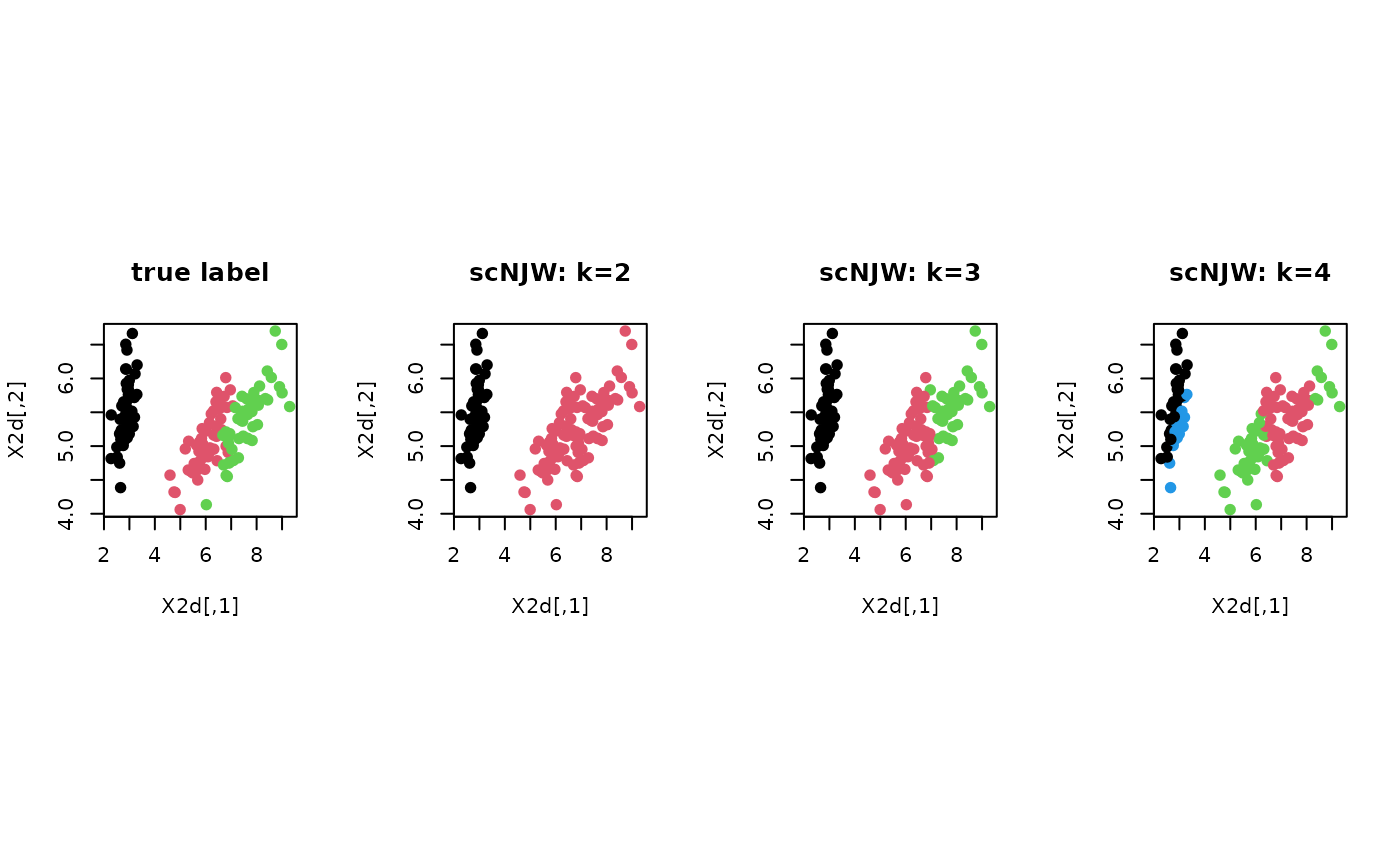
## CLUSTERING WITH DIFFERENT K VALUES
cl2 = scNJW(X, k=2)$cluster
cl3 = scNJW(X, k=3)$cluster
cl4 = scNJW(X, k=4)$cluster
## VISUALIZATION
opar <- par(no.readonly=TRUE)
par(mfrow=c(1,4), pty="s")
plot(X2d, col=lab, pch=19, main="true label")
plot(X2d, col=cl2, pch=19, main="scNJW: k=2")
plot(X2d, col=cl3, pch=19, main="scNJW: k=3")
plot(X2d, col=cl4, pch=19, main="scNJW: k=4")
 par(opar)